
How to Choose Circuit Breaker Parts for Global Sourcing?

Choosing Circuit Breaker Parts for global sourcing is not simply a price comparison. It requires careful review of performance, compatibility, traceability, and supplier capability. A breaker may look identical in a catalog, yet its contact alloy, molded housing, trip mechanism, or terminal design can change its safety performance. Experienced sourcing teams begin with the application: rated current, voltage, frequency, interrupting capacity, pole configuration, and operating environment. They also confirm whether the part is original, approved equivalent, or a custom alternative.

Details matter.

Reliable buyers request current datasheets, dimensional drawings, material declarations, inspection records, and sample units before placing large orders. They compare thermal-magnetic trip curves, terminal torque values, insulation ratings, and mechanical endurance results. Supplier audits can reveal practical weaknesses, such as poor storage conditions, inconsistent labeling, or uncalibrated test equipment. These findings often matter more than a polished website. A qualified manufacturer should explain its quality controls clearly and provide batch-level traceability.

Global sourcing also demands disciplined communication. Product names, certification marks, packaging labels, and test methods should match the destination market’s requirements. Regional differences can affect acceptance, installation, and replacement decisions. However, no checklist is perfect. A supplier may pass an initial review and still change materials later. Therefore, buyers should define change-notification rules, incoming inspection steps, and corrective-action procedures in writing. The safest choice is rarely the cheapest offer. It is the option supported by verified evidence, stable production, and transparent technical discussion. That judgment takes experience, and sometimes a second review is necessary.
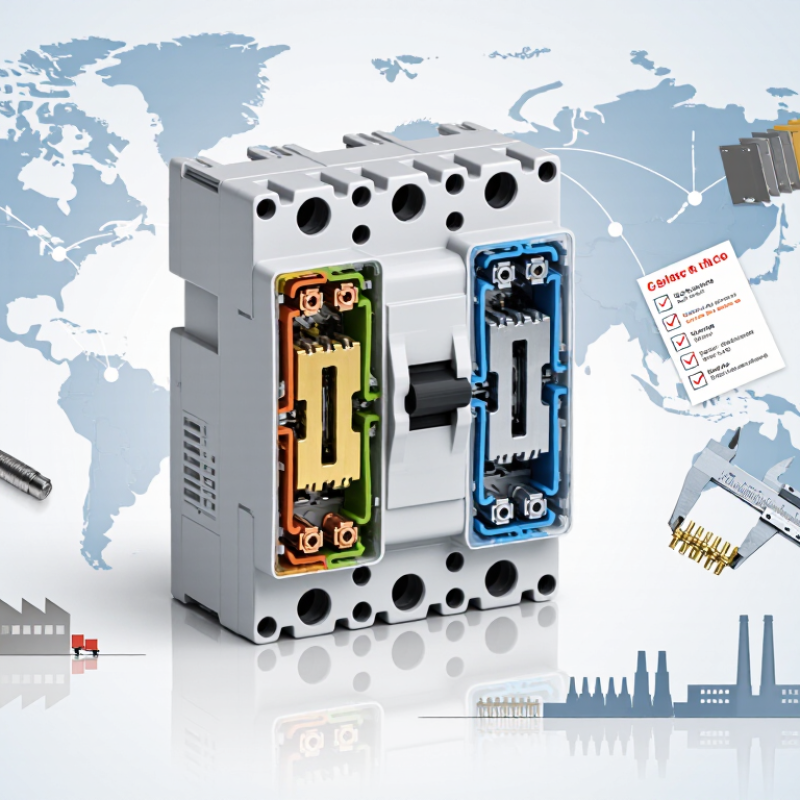
How to Choose Circuit Breaker Parts for Global Sourcing?

Set Ratings: IEC 60898-1, 1–125 A, Up to 25 kA

For global sourcing, begin with the rating frame in IEC 60898-1. The standard covers circuit breakers rated from 1 to 125 A, with short-circuit capacity up to 25 kA. Confirm the intended system voltage, frequency, pole arrangement, and tripping curve. A 16 A device for lighting may not suit a motor circuit. Small errors become expensive quickly.

The IEA Electricity 2025 report states that global electricity demand increased by about 4.3% in 2024. Its Electricity 2024 report also projected average annual growth of 3.3% through 2026. This expanding demand increases pressure on suppliers to prove consistent ratings, thermal performance, and fault interruption. Ask for test reports linked to the exact model, not a similar family. Verify marking, calibration records, and sample performance. I would not rely on a catalog number alone. It looks efficient, but it can hide a mismatch.

Tips: Build a rating matrix before requesting quotations. Record current, voltage, curve, poles, frequency, and 25 kA verification. Request certificates from accredited laboratories, then compare them with IEC 60898-1 clauses. Check ten samples, if practical. One sample can flatter a weak batch. Review packaging and terminal torque instructions too; installation details can affect real protection.

Map Industrial Parts to IEC 60947-2 and UL 489

How to Choose Circuit Breaker Parts for Global Sourcing?

Map Industrial Parts to IEC 60947-2 and UL 489

Global sourcing becomes safer when every circuit breaker part has a clear standards map. IEC 60947-2 covers low-voltage circuit breakers up to 1,000 V AC and 1,500 V DC. UL 489 addresses molded-case and enclosed circuit breakers used in North American installations. Do not match parts by appearance alone. Record rated voltage, continuous current, interrupting capacity, trip curve, pole arrangement, terminal temperature, and enclosure conditions. A 250 A breaker may still fail if its short-circuit rating is unsuitable.

The IEA Electricity 2024 report projects global electricity demand growth of about 3.4% annually from 2024 to 2026. More load means stronger pressure on protection equipment and replacement inventories. For each candidate part, request test reports, calibration records, material declarations, and production-lot traceability. Check whether the report covers the exact frame size and accessory combination. Small differences matter. A shunt trip, auxiliary contact, or busbar adapter can change compliance status. This is where sourcing teams sometimes guess.

Tips: Build one comparison sheet for IEC and UL requirements. Photograph terminal markings and trip settings. Confirm local installation rules before ordering. Ask for samples from the actual production lot, not only a catalog unit. Keep a technical reviewer involved. Spreadsheets help, but they are not proof. Reviewers should challenge missing data, even when delivery pressure is high.

Choose B, C, or D Trip Curves and 1–4 Pole Configurations

Choosing Circuit Breaker Parts for Global Sourcing

Trip curves and pole counts deserve more attention than appearance. In field audits, I have seen compact breakers selected correctly for voltage but incorrectly for inrush current. That mistake can cause nuisance trips.

A B-curve typically trips magnetically at three to five times rated current. It suits lighting, heating, and resistive circuits. A C-curve responds at five to ten times rated current. It is often better for small motors, pumps, and mixed commercial loads. A D-curve may require ten to twenty times rated current. Use it only when transformers, compressors, or heavy motors justify the higher threshold. The wrong curve can delay fault interruption. Worse, it may hide an undersized cable.

Pole configuration must match the distribution system. One-pole protection usually serves a single live conductor. Two-pole devices can disconnect line and neutral together, where the system requires it. Three-pole versions serve three-phase equipment, while four-pole units also switch the neutral. IEC 60898-1 and IEC 60947-2 define important performance and testing requirements, but local installation rules still matter. Never treat “four poles” as automatically safer.

The IEA’s Electricity 2024 report projects global electricity demand growth of about 3.4% annually through 2026. That growth increases pressure on reliable low-voltage protection. Market reports also forecast continued expansion in circuit breaker demand, though their figures differ. This is a useful warning: verify temperature derating, interrupting capacity, terminal size, and certification for each destination. I once prioritized a lower unit price and overlooked enclosure heat. It was not a clever saving.

Check RoHS: 10 Restricted Substances; Screen REACH SVHCs

When sourcing circuit breaker parts globally, treat RoHS and REACH screening as separate checks. RoHS currently restricts ten substances: lead, mercury, cadmium, hexavalent chromium, PBB, PBDE, DEHP, BBP, DBP, and DIBP. They may appear in contacts, solder, insulation, cable jackets, or flame-retardant plastics. Ask suppliers for material declarations, not only a general compliance letter.

Details matter. A supplier’s test report should identify the exact part number, production batch, test method, and laboratory date. XRF screening can quickly detect several metals, but it cannot confirm every restricted substance. Polymer additives often need laboratory analysis. Keep samples from terminals, housings, and insulation separate. Small parts deserve attention too.

REACH SVHC screening requires a different workflow. Compare every material and article against the current Candidate List, because substances and obligations can change. Check whether an SVHC exceeds 0.1% by weight in an article, where applicable, and request substance names with concentration ranges. A factory statement alone may be incomplete. I have seen declarations copied across product families, even when insulation grades changed. That is a warning sign. Build a traceable evidence file, verify high-risk materials independently, and record the date of each review. Some screening decisions remain uncertain until the supplier provides formulation-level information.

How to Choose Circuit Breaker Parts for Global Sourcing? - Check RoHS: 10 Restricted Substances; Screen REACH SVHCs

Regulatory Reference Data

Compliance Topic Requirement or Threshold What to Check in Circuit Breaker Parts Recommended Record
RoHS restricted substances RoHS restricts 10 substances in electrical and electronic equipment: lead, mercury, cadmium, hexavalent chromium, PBB, PBDE, DEHP, BBP, DBP and DIBP. Evaluate every homogeneous material, including metal coatings, polymer compounds, cable insulation, labels, solder, adhesives and lubricants. Material declaration, supplier compliance statement, technical datasheet and test report where risk justifies testing.
RoHS concentration limits Maximum concentration is generally 0.1% by weight in homogeneous material. Cadmium has a lower limit of 0.01%. Do not average a complete breaker or assembly. Separate plating, plastic, solder, adhesive and other homogeneous materials for assessment. Homogeneous-material composition table with units in % by weight and the applicable exemption, if any.
RoHS exemptions Some applications may qualify for specific, time-limited exemptions listed in the applicable RoHS annexes. Confirm that any claimed exemption matches the exact part, application and legal validity period. Do not treat an exemption as a general product waiver. Exemption number, scope, expiry review date and written technical justification.
REACH SVHC screening Screen against the latest ECHA Candidate List available on the assessment date. The list can change as substances are added. Check plastics, rubber, coatings, cables, adhesives, lubricants, flame-retardant systems, metal treatments and articles supplied with the part. Signed SVHC declaration showing the Candidate List revision or publication date used for screening.
REACH Article 33 If an article contains a Candidate List substance above 0.1% by weight, recipients must receive sufficient information for safe use, at minimum the substance name. Request substance identity, concentration range, affected article or material and safe-use information when the threshold is exceeded. Article-level disclosure, safe-use instructions and supply-chain communication record.
EU SCIP obligation For articles placed on the EU market that contain a Candidate List substance above 0.1% by weight, relevant SCIP information may be required. Ask whether the responsible EU economic operator has completed the applicable SCIP submission and can provide the required article information. SCIP reference or documented rationale when no SCIP submission is applicable.

RoHS: The 10 Restricted Substances

Substance RoHS Limit in Homogeneous Material Common Circuit Breaker Part Risk Typical Verification Evidence
Lead (Pb) 0.1% Copper alloys, metal plating, solder, pigments, stabilizers and legacy component materials. Material declaration, alloy specification, plating declaration and targeted laboratory test where needed.
Mercury (Hg) 0.1% Specialized switches, lamps or legacy electrical components incorporated into an assembly. Supplier declaration and component-level substance screening.
Cadmium (Cd) 0.01% Metal coatings, pigments, contacts, batteries or older plastic formulations. Material declaration plus targeted analysis because the limit is lower than the general RoHS limit.
Hexavalent chromium (Cr(VI)) 0.1% Conversion coatings, corrosion-protection treatments and certain plated steel parts. Plating process declaration and coating test report where applicable.
Polybrominated biphenyls (PBB) 0.1% Legacy flame-retarded plastics, cable insulation and molded insulating components. Polymer formulation declaration and laboratory screening if formulation control is uncertain.
Polybrominated diphenyl ethers (PBDE) 0.1% Legacy flame-retarded thermoplastics, electrical housings and internal insulating parts. Polymer supplier declaration and analytical screening for high-risk or recycled-content materials.
Bis(2-ethylhexyl) phthalate (DEHP) 0.1% Flexible PVC cable insulation, seals, grommets and soft polymer components. PVC formulation data, plasticizer declaration and targeted phthalate test.
Benzyl butyl phthalate (BBP) 0.1% Flexible PVC, elastomeric parts, wire insulation and soft-touch compounds. Polymer composition declaration and laboratory test when soft PVC is used.
Dibutyl phthalate (DBP) 0.1% Plasticized polymers, sealants, adhesives and certain flexible electrical materials. Formulation declaration, supplier certificate and targeted phthalate analysis.
Diisobutyl phthalate (DIBP) 0.1% Plasticized polymers, adhesives, cable materials and soft insulating parts. Formulation declaration and test report covering the four RoHS phthalates.

Part-Level Sourcing and Screening Matrix

Part Category Typical Material or Process RoHS Screening Focus REACH SVHC Screening Focus Minimum Evidence to Request Sourcing Gate
Housing and cover Engineering thermoplastic, thermoset plastic, pigment, flame-retardant package and molded inserts. Lead, cadmium, PBB, PBDE and RoHS phthalates; verify each resin or compound grade. Candidate List substances in flame retardants, pigments, additives, recycled content and molded inserts. Resin grade, full material declaration, recycled-content statement and SVHC declaration. Required
Line and load terminals Copper or copper alloy, tin or other plating, screws and surface-treatment chemicals. Lead and hexavalent chromium in alloy or coating; confirm coating process and homogeneous-material breakdown. SVHCs in plating chemicals, surface treatments, corrosion inhibitors or metal alloys. Alloy composition, plating specification, process declaration and supplier SVHC statement. Required
Electrical contacts Contact alloy, silver-containing material, copper alloy, rivet and weld interface. Lead, cadmium and hexavalent chromium; assess contact material separately from the carrier. Candidate List substances in contact materials, binders, coatings and manufacturing residues. Contact alloy certificate, coating declaration and substance disclosure by homogeneous material. Required
Arc chute and insulating barriers High-temperature polymer, ceramic, mineral filler, glass fiber or molded insulating material. Halogenated flame retardants, pigments, lead, cadmium and phthalates in polymer systems. SVHCs in flame-retardant packages, binders, fillers and processing aids. Material grade, formulation declaration, flame-retardant declaration and SVHC screening. Required
Trip mechanism and springs Carbon steel, stainless steel, copper alloy, lubricant and protective coating. Lead in alloys, hexavalent chromium in coatings and regulated substances in lubricants. SVHCs in oils, greases, corrosion inhibitors, coatings and surface-treatment residues. Metal grade, coating process, lubricant SDS and current SVHC declaration. Recommended
Internal wiring and cable assemblies Copper conductor, PVC or other polymer insulation, terminals and cable markers. Lead, PBB, PBDE and DEHP, BBP, DBP and DIBP in insulation, jackets and markers. SVHCs in flexible insulation, additives, pigments and cable-processing materials. Cable construction, insulation material, phthalate test or declaration and SVHC statement. Required
Electronic trip unit or PCB assembly Printed circuit board, solder, semiconductor packages, connectors, coatings and capacitors. Lead in solder and component finishes; verify any applicable RoHS exemption separately. SVHCs in PCB laminates, coatings, encapsulants, connectors, soldering materials and thermal compounds. PCB material declaration, solder alloy, component declarations and exemption review. Required
Seals, gaskets and operating accessories Rubber, elastomer, silicone, plastic, adhesive and lubricated interfaces. RoHS phthalates and heavy metals in pigments, plasticizers, adhesives and surface treatments. SVHCs in plasticizers, curing agents, pigments, adhesives and specialty additives. Compound declaration, SDS where applicable, adhesive data and current SVHC statement. Recommended
Labels and packaging Printed paper, plastic label film, ink, adhesive, carton, foam and protective bag. Lead, cadmium, hexavalent chromium, PBDE/PBB and phthalates in inks, films and adhesives. SVHCs in adhesives, inks, plastic films, foam and packaging additives. Packaging material declaration, ink and adhesive information, and SVHC statement. Screen
Global sourcing rule: Obtain a separate declaration for each part number and material family, record the applicable RoHS and REACH assessment dates, and require immediate notification when a formulation, supplier, coating, recycled-content ratio or regulatory list changes.
Reference basis: RoHS substance limits are assessed at homogeneous-material level. REACH SVHC status must be checked against the latest applicable ECHA Candidate List and the destination-market obligations in force at the time of placing the article on the market.

Audit Suppliers: ISO 9001, Type Tests, MOQ, Lead Time, and Incoterms

When sourcing circuit breaker parts globally, audit the supplier before comparing price. ISO 9001 matters because it indicates a documented quality system, not automatic product compliance. The ISO Survey 2022 recorded 1,265,216 ISO 9001 certificates worldwide, but certificates still require verification. Check the certificate scope, issuing body, site address, and expiry date. Ask for incoming inspection records, calibration logs, and corrective-action reports. Small gaps matter.

Type tests need harder evidence. Request reports covering the applicable IEC 60947-2 ratings, including short-circuit performance, temperature rise, dielectric strength, and mechanical endurance. Confirm the tested frame size, trip unit, pole configuration, and rated current match your intended part. A copied report is not enough. Contact the laboratory when permitted. I have seen attractive reports with mismatched product codes. That mistake is expensive.

Commercial checks should be equally precise. Record MOQ by part number, annual volume assumptions, tooling ownership, and sample charges. Separate production lead time from shipping time. Ask for capacity during peak months and a written escalation plan. The World Bank’s 2023 Logistics Performance Index covered 139 economies, showing why route reliability and customs capability deserve attention. Select Incoterms only after identifying who controls export clearance, insurance, freight, and destination handling. DAP may simplify delivery, but it can hide local tax and customs responsibilities. FCA can improve control, yet it demands a capable freight process. Recheck these assumptions quarterly. Market conditions change.

Go to Top