
Top 10 Types of Geosynthetic Materials for Global Buyers

Choosing the right geosynthetic product can determine whether a civil engineering project performs reliably for decades. This guide introduces ten major types of Geo Synthetic Materials used in roads, railways, drainage systems, landfills, erosion control, and coastal works. Each category serves a different purpose. Some separate unstable soil layers, while others reinforce embankments or control water movement.

Global buyers need more than a product catalogue. They should examine polymer type, tensile strength, puncture resistance, permeability, UV stability, and installation conditions. A geotextile that performs well beneath a European roadway may require different specifications in a humid tropical region. Soil chemistry, temperature changes, rainfall intensity, and construction equipment can alter results. Small details matter.

Field experience shows that many failures begin with unclear specifications or rushed installation. A strong product cannot correct poor site preparation. It is also unwise to compare prices without checking service life and testing records. No shortlist is flawless. Project teams may still need to revise their choice after laboratory testing or trial installation. Reliable suppliers should provide technical datasheets, quality certificates, batch traceability, and applicable standards. Buyers should also confirm whether independent testing supports the manufacturer’s claims.

The following overview compares ten widely used materials, including geotextiles, geogrids, geomembranes, geocomposites, and geosynthetic clay liners. It focuses on practical functions, selection criteria, and common applications. The goal is not to promote one material. It is to help international purchasers ask sharper questions and make safer, evidence-based decisions.
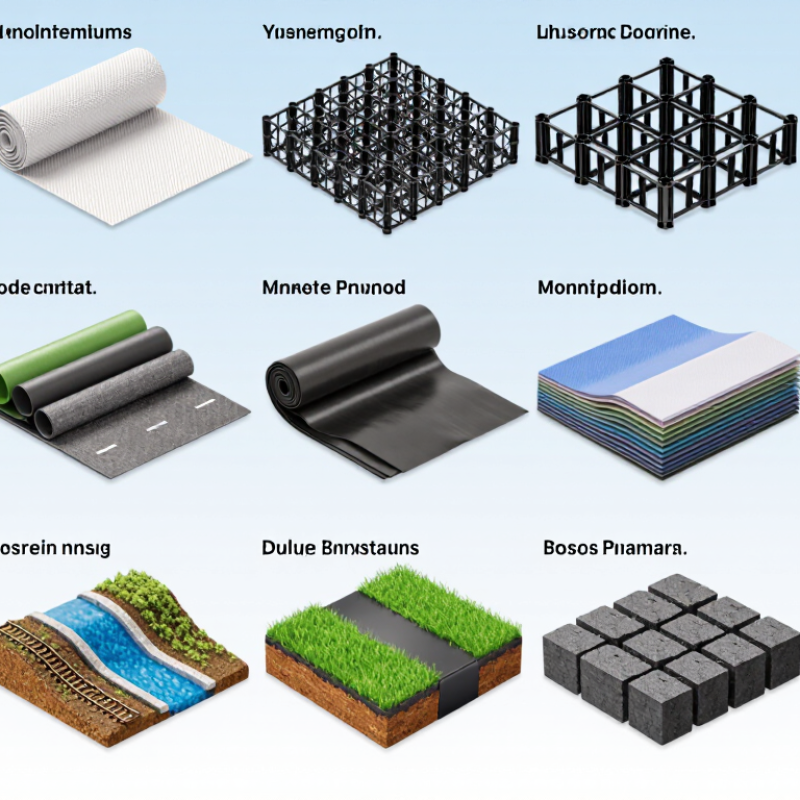
Top 10 Types of Geosynthetic Materials for Global Buyers

Geotextiles and Geogrids: ISO 10319 Strength, AOS, and Aperture Data

For global buyers, geosynthetic selection starts with comparable test data, not attractive product names. ISO 10319 wide-width tensile testing reports strength and elongation under controlled conditions. Ask whether results cover machine and cross-machine directions. Direction matters.

Geotextile AOS indicates the apparent opening size, usually reported through a standardized sieve-based method. A smaller AOS can help retain soil particles, but it may reduce water passage. Check permeability beside AOS. One number never tells the whole story.

For geogrids, aperture dimensions and rib geometry influence aggregate interlock. Measure both aperture length and width, then compare them with the project’s aggregate size.

Procurement teams should request recent laboratory reports, sample identification, test speed, specimen width, and failure mode. Certificates without these details deserve careful review. ISO 10319 strength is not automatically comparable with every national test method. Small differences in conditioning or clamping can change the result.

Field handling also matters. A strong geogrid may lose performance after sharp aggregate damages its ribs. Geotextiles can suffer punctures during placement, even when factory values look excellent. That part is often underestimated.

I would also verify production-lot consistency, because one impressive sample cannot represent an entire shipment. Some specifications remain too rigid, and this is worth reconsidering when soil, drainage, and installation conditions vary.

Geomembranes and GCLs: 0.75–3.0 mm Liners and ASTM D5887 Flux Tests

For global buyers, geomembranes and geosynthetic clay liners require different evaluation methods. A geomembrane usually ranges from 0.75 to 3.0 mm thick. Its performance depends on polymer quality, thickness consistency, tensile strength, and welded seam integrity. Thicker liners can improve puncture resistance, but thickness alone does not guarantee long-term containment.

A GCL uses bentonite between geotextile layers. It forms a low-permeability barrier after proper hydration and confinement. ASTM D5887 measures flux through a saturated GCL specimen under controlled pressure. It does not replace geomembrane seam testing. Buyers should review test pressure, specimen conditioning, bentonite mass, and reported flux units before comparing suppliers. Small differences in these details can change the result.

Field experience shows that installation conditions often decide performance. Rough subgrades may puncture a 0.75 mm liner, while poor overlaps can weaken a GCL barrier. Clean water is important during hydration; saline or contaminated water may reduce bentonite swelling. Project teams should request factory quality records, independent laboratory data, and installation inspection reports. A carefully tested product can still fail when drainage layers create unexpected stress. That uncomfortable possibility deserves attention. Specification reviews should include temperature, chemical exposure, slope movement, and site-specific confinement conditions.

Geonets and Geocomposites: ASTM D4716 Transmissivity and Drainage Data

Among the top ten geosynthetic materials, geonets and geocomposites deserve careful attention in drainage design. Their key performance indicator is transmissivity, which describes in-plane water flow under a selected load and hydraulic gradient. ASTM D4716 provides a controlled method for measuring this behavior. It helps buyers compare drainage products under similar laboratory conditions.

The test applies normal pressure to a specimen while water moves through its drainage core. Engineers record flow rate, gradient, and applied stress. Higher pressure can compress the core and reduce available flow space. That detail matters beneath roads, retaining walls, and landfill covers. Ask for test data at conditions close to the project. A value measured at low pressure may not represent field performance.

Look closely at specimen preparation and test duration. Wrinkles, blocked edges, poor contact, or incomplete conditioning can distort results. Geocomposites may also face filter clogging, while geonets can lose capacity when soil particles enter their channels. Laboratory data is useful, not perfect. Field installation remains important. Request transmissivity curves, normal stress levels, hydraulic gradients, and thickness changes. Do not compare one isolated number with another without checking the test conditions. Small differences in loading can create large design errors.

Top 10 Types of Geosynthetic Materials for Global Buyers

Geonets and Geocomposites: ASTM D4716 Transmissivity and Drainage Data

The chart compares representative screening values for transmissivity at a 20 kPa normal stress and a hydraulic gradient of 1.0. Transmissivity is reported in m²/s and should be verified through project-specific ASTM D4716 testing because results vary with material structure, confinement, gradient, temperature, and adjacent soil or filter layers. These values are engineering examples rather than product specifications.

Geocells and Geofoam: 75–200 mm Confinement and 15–30 kg/m³ Density

Geocells and geofoam serve different jobs within the geosynthetic materials market. Geocells create three-dimensional confinement, commonly using 75–200 mm cell depths. This structure limits lateral aggregate movement under roads, slopes, and working platforms. The Federal Highway Administration’s Geosynthetic Design and Construction Guidelines, FHWA-NHI-07-092, emphasizes infill quality, drainage, and interface friction during design. Size alone does not guarantee performance.

Geofoam offers lightweight fill, typically with a density of 15–30 kg/m³. ASTM D6817 classifies rigid cellular polystyrene geofoam by density and compressive resistance. At this range, contractors can reduce vertical stress over weak soil and simplify installation beside bridges or buried utilities. A cubic metre may weigh only a fraction of conventional granular fill. That difference becomes visible when trucks arrive less often and cranes handle smaller loads.

Field decisions still require caution. Water exposure, temporary loads, creep, joints, and fire protection cannot be ignored. A compact geocell layer may look perfect, yet poor compaction inside each cell can reduce support. Geofoam may also be selected from a catalogue without checking long-term compression. That assumption can be wrong. The FHWA guidance supports site-specific testing, while ASTM-based certificates should be reviewed against actual project temperatures and loads. Buyers should request density, compressive resistance, dimensional tolerances, and installation records. The paperwork matters. The ground decides.

Geopipes and Erosion-Control Mats: ASTM F405 Flow and D6460 Performance

Geopipes and erosion-control mats serve different hydraulic roles, yet both demand careful performance checks. For drainage projects, ASTM F405 supports the evaluation of corrugated polyethylene tubing and fittings. Buyers should review pipe dimensions, stiffness, joint quality, and installation conditions. Flow does not depend on diameter alone. Slope, roughness, bends, and sediment also influence discharge.

A practical inspection starts with the pipe interior. It should feel clean and uniform, without crushed sections or sharp deformation. Confirming the expected flow requires hydraulic calculations under the project’s actual conditions. ASTM F405 is useful for product conformity, but it cannot replace field design judgment. That distinction is easy to miss.

Erosion-control mats require another performance lens. ASTM D6460 evaluates how well these products protect soil during simulated rainfall and surface runoff. Test results can reveal sediment loss, rill formation, and mat movement on a prepared slope. Buyers should compare test conditions with their own soil, gradient, rainfall intensity, and installation method. A mat that performs well in testing may struggle when staples loosen or the ground remains uneven. Field experience says installation often decides the outcome. Inspection should continue after heavy rain, not only at delivery. Procurement teams sometimes focus too heavily on laboratory numbers. That is understandable, but incomplete.

Top 10 Types of Geosynthetic Materials for Global Buyers - Geopipes and Erosion-Control Mats: ASTM F405 Flow and D6460 Performance
No. Geosynthetic Type Typical Polymer / Structure Primary Function Key Performance Dimension Commonly Referenced Standards or Tests Typical Applications
1 Woven Geotextile Woven polypropylene or polyethylene tapes, yarns, or slit films Separation, reinforcement, filtration, and limited drainage High tensile strength and low elongation; apparent opening size and permittivity control soil-retention and water-flow behavior ASTM D4595, ASTM D4632, ASTM D4751, ASTM D4491, ASTM D6241 Road bases, embankments, working platforms, soil reinforcement, and erosion-control underlayers
2 Nonwoven Geotextile Needle-punched or heat-bonded polypropylene or polyester fibers Filtration, separation, cushioning, and drainage Permittivity, transmissivity, puncture resistance, and filtration opening size; performance depends on soil compatibility and loading ASTM D4491, ASTM D4751, ASTM D4632, ASTM D4833, ASTM D4716 Subsurface drainage, filter layers, landfill systems, wrapped drains, and protection layers
3 Geomembrane Flexible polyethylene, PVC, polypropylene, or other polymer sheet Liquid and vapor containment Very low permeability, seam integrity, chemical resistance, puncture resistance, and weathering durability ASTM D638, ASTM D6693, ASTM D4833, ASTM D5397, ASTM D5820, ASTM D6392 Reservoirs, ponds, canals, wastewater facilities, mining containment, and landfill liners
4 Geogrid Oriented or woven polymer grid, commonly made from polypropylene or polyester Soil and aggregate reinforcement Aperture geometry, tensile strength, junction strength, installation damage resistance, and long-term design strength ASTM D6637, ASTM D7737, ASTM D7738, ASTM D5818 Reinforced soil walls, paved roads, rail platforms, slopes, and foundation improvement
5 Geonet Extruded polymer drainage net, usually high-density polyethylene In-plane liquid or gas drainage Transmissivity under normal load, compression creep, interface friction, and flow-path continuity ASTM D4716, ASTM D5199, ASTM D5321, ASTM D6364 Landfill leachate drainage, cover systems, retaining walls, and foundation drainage
6 Geocomposite Drainage Layer Geonet or cuspated core combined with one or more geotextile filters Combined filtration, separation, and drainage Long-term transmissivity, filtration compatibility, compressive behavior, and resistance to clogging ASTM D4716, ASTM D4491, ASTM D4751, ASTM D6364 Basement walls, landfills, road drainage, green roofs, and capillary-break systems
7 Geosynthetic Clay Liner (GCL) Sodium bentonite layer supported by woven and/or nonwoven geotextiles Low-permeability hydraulic barrier Hydraulic conductivity, swell behavior, peel or internal shear strength, and compatibility with the contained liquid ASTM D5887, ASTM D5891, ASTM D6243, ASTM D6496 Landfill liners and covers, ponds, canals, secondary containment, and remediation caps
8 Geocell Three-dimensional interconnected polymeric cell network, commonly high-density polyethylene Lateral confinement, load distribution, and surface stabilization Cell depth and size, seam strength, confinement efficiency, and resistance to ultraviolet exposure and installation damage ASTM D4885, ASTM D4355, ASTM D6693, project-specific load and pullout testing Unpaved roads, steep slopes, channels, drainage ditches, and erosion-resistant soil or aggregate surfaces
9 Corrugated Polyethylene Geopipe Corrugated polyethylene tubing; perforated or solid-wall configurations are selected by drainage or conveyance requirements Collection, conveyance, or discharge of water Hydraulic flow capacity, inside diameter, perforation pattern, ring stiffness, deflection, joint performance, and installation backfill ASTM F405 for corrugated PE tubing and fittings; ASTM D2412 for external-load pipe stiffness; hydraulic capacity verified using project design calculations French drains, roadway edge drains, foundation drains, agricultural drainage, and stormwater systems
10 Erosion-Control Mat or Blanket Biodegradable natural fibers or synthetic polymer fibers formed as woven, nonwoven, or three-dimensional mats Temporary or permanent protection of soil from rainfall and surface runoff Rainfall-induced soil-loss reduction, shear resistance, vegetation establishment, longevity, and permissible hydraulic shear stress ASTM D6460 for erosion-control blanket performance on hillslopes; ASTM D6459 for open-channel performance; ASTM D6525 for mass per unit area Slopes, swales, drainage channels, streambanks, construction sites, and revegetation projects
Buyer note: Actual flow rate, service life, allowable load, and erosion-control performance are project-specific. Product selection should be verified against site soil, hydraulic conditions, installation method, chemical exposure, design loads, and the applicable edition and scope of each test standard.
Go to Top